
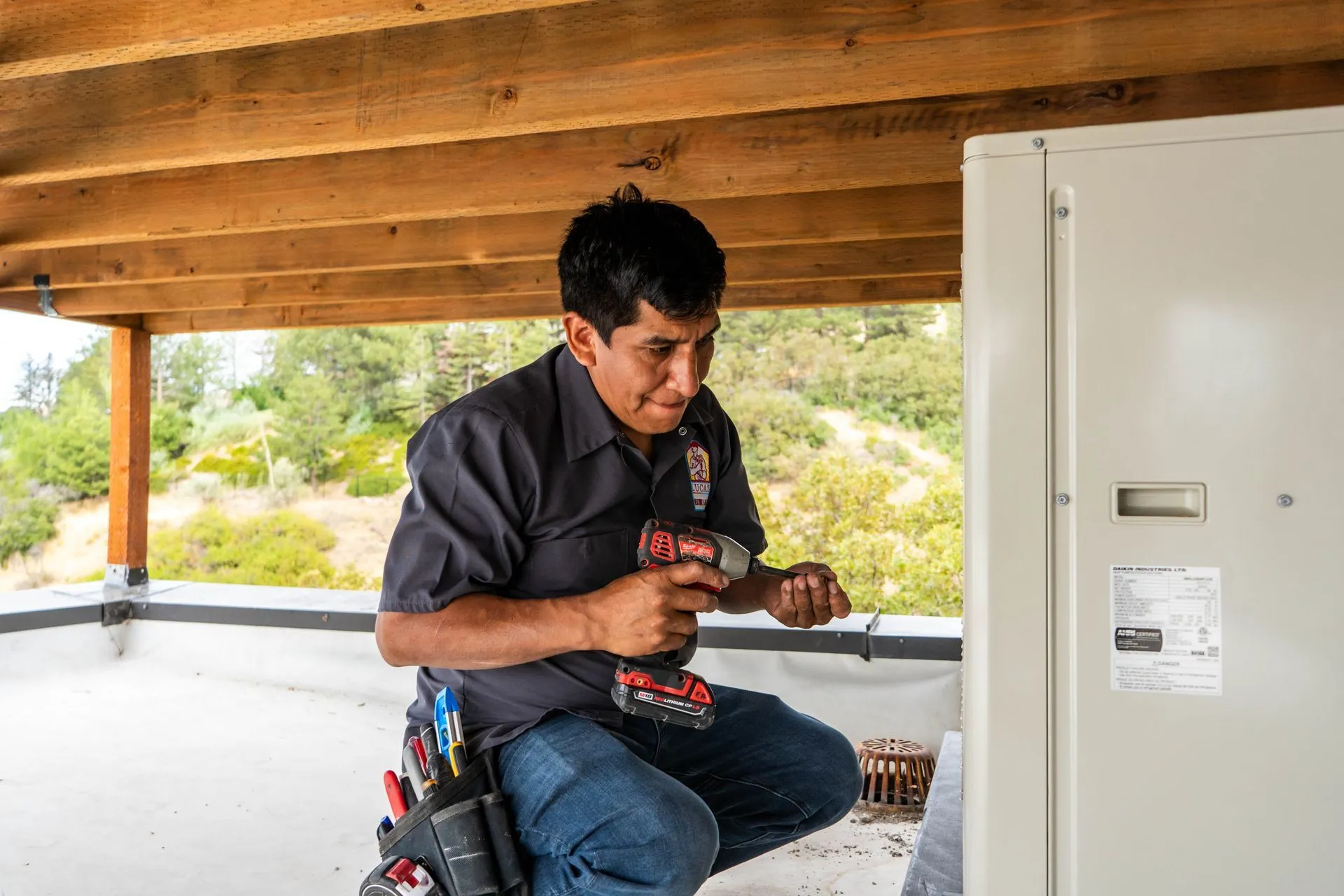
If your air conditioner made it through this August by the skin of its teeth — running all day, icing up, blowing air that was “cool-ish” at best — you’re probably asking the question every Utah homeowner eventually faces: fix it one more time, or replace it before next summer?
There’s no universal answer, but there is a short list of questions that settles it for most houses. Here’s how we walk customers through it, with the same honesty we’d want in our own garage.
The three questions that decide it
1. How old is it? Find the manufacture date on the outdoor unit’s data plate (it’s usually in the serial number, or printed outright). Along the Wasatch Front, central ACs typically give 12–15 good years. Under 10 years old, repair almost always wins. Past 15, put real thought into replacement before you spend serious money on parts.
2. What does the repair cost against the unit’s value? The industry rule of thumb is the “$5,000 rule”: multiply the repair quote by the system’s age. A $400 repair on an 8-year-old unit scores 3,200 — repair it. A $900 repair on a 14-year-old unit scores 12,600 — that money is a down payment on equipment that won’t strand you next July. It’s a rule of thumb, not gospel, but it catches the throwing-good-money-after-bad trap that costs homeowners the most.
3. How often are we meeting? One repair in a decade is normal wear. Two service calls in the same summer is a pattern. Aging systems rarely fail once — compressors, fan motors, and coils tend to go downhill together, because they’ve all baked through the same fifteen Utah summers.
The 2026 wrinkle: refrigerant is changing again
There’s a fourth factor now that didn’t exist a few years ago. The refrigerant in most Utah systems installed between roughly 2010 and 2024 is R-410A — and as of 2025, new equipment has moved to a new generation of refrigerants under federal phasedown rules. R-410A itself isn’t banned, and existing systems can keep running and being serviced. But as supply tightens over the coming years, refrigerant-related repairs on older units — leaks especially — get steadily more expensive.
Practically, that means: a leak repair plus a recharge on an aging R-410A system deserves harder scrutiny than it did in 2022. And if your system is old enough to run R-22 (banned from production since 2020), a refrigerant leak is effectively a replacement conversation — honest shops stopped recommending R-22 top-offs years ago.
Finding out doesn’t need to cost much
You don’t have to decide any of this blind. Our diagnostic visit is a flat $69 — a technician looks at the actual system and tells you exactly what’s wrong and what it costs to fix. If you go ahead with the repair, the $69 is waived. If the honest answer is “this unit is done,” the $69 is credited toward the new install. Either way, you never pay to find out what’s wrong and then pay again to act on it.
That structure exists on purpose: it takes away our incentive to talk you into anything. The diagnosis is the same whichever way you decide.
If replacement wins, here’s what it actually looks like
A few things worth knowing before you collect bids — from us or anyone else:
- A real quote follows a real look at the house. Equipment size should come from a load calculation, not from copying whatever number is on the old unit. Utah’s altitude, your ductwork, and your home’s windows and insulation all move it. Our Utah HVAC cost guide covers the market price ranges and the six factors that swing every bid.
- Every Lucas replacement is finished in one day. Old unit out in the morning, new one cooling by evening — nobody spends a summer night without AC just for choosing to upgrade.
- Every install carries our free 5-year labor warranty, in writing. Most companies cover workmanship for a year or two; we put five on paper.
- Think about a heat pump while you’re at it. If your furnace is also aging, a heat pump can replace the AC and carry most of your winter heating. The federal 25C tax credit expired at the end of 2025 — don’t let anyone dangle it — but Rocky Mountain Power’s Wattsmart rebates are still active on qualifying equipment. Current verified amounts live on our rebates page.
- Spreading the cost out is fine. Financing options are available, and checking what you qualify for won’t affect your credit.
Why fall is the smart window
Here’s the quiet advantage of deciding now instead of next June: September and October are shoulder season. Install schedules are open, you can pick your day instead of taking what’s left, and you’re not making a four-figure decision while the house is 88 degrees and the kids are melting. The homeowners who replace in fall shop calmly, compare bids properly, and start next summer with a warranty instead of a worry.
If your AC barely survived August, don’t wait for it to fail in a July heat wave — that’s when everyone else calls too.
Not sure which side of the line your system is on? Book the $69 diagnostic or call or text (801) 678-5748 — phones are answered Monday through Friday, 8 AM to 8 PM, in English or Spanish. If it’s worth fixing, we’ll fix it. If it isn’t, we’ll say so and show you the math.