
The honest numbers
HVAC Costs in Utah: What Actually Drives the Price (2026)
Across the Utah market in 2026, replacing a central AC generally runs $3,500 to $9,000+, a gas furnace $3,800 to $12,000, and a full furnace-and-AC system $8,000 to $16,000+. Those are market-wide figures from published cost guides — not our quotes. The spread is wide because six things about your house move the number, and this page walks through all six so the bids you collect make sense.
What HVAC work costs across the Utah market in 2026
The ranges below come from national and Utah cost guides, not from our price book. Utah runs wider than the national average because the Salt Lake Valley mixes 1905 bungalows with brand-new Daybreak builds, and because altitude changes what equipment a home needs. Use these to judge whether a bid is in the neighborhood; your real number comes from someone standing in your house.
| Job | Typical market range (2026) | What pushes it toward the top |
|---|---|---|
| Central AC replacement | $3,500 – $9,000+ | Larger homes, high-efficiency equipment, electrical upgrades |
| Gas furnace replacement | $3,800 – $12,000 (most mid-efficiency jobs: $4,500 – $6,300) | 96%+ AFUE models, venting changes, tight installs |
| Furnace + AC together | $8,000 – $16,000+ | Premium equipment tiers, ductwork corrections |
| Ducted heat pump | $4,500 – $12,500 | Cold-climate models, dual-fuel setups, home size |
| Ductless mini-split | $2,000 – $5,500 single zone · $4,000 – $18,000 multi-zone | Each added zone; long line-set runs |
| Typical repair visit | $150 – $450 for most repairs · $500 – $2,800 for major components | Compressors, coils, and refrigerant leaks sit at the top |
Sources: Angi's 2026 HVAC replacement data, HomeGuide's gas furnace guide, Fixr's furnace cost data, HVAC Base's heat pump pricing, HomeGuide's HVAC repair data. All figures are market-wide, checked August 12, 2026.
Why we don't print our own install prices: because they'd be wrong for your house. Every quote we write follows a walk through the actual home — and replacement estimates are free, so finding out your real number costs nothing.
The six things that move every HVAC price
1. Equipment tier
Two bids can both say "new AC" and sit $3,000 apart on equipment alone. National guides put equipment at roughly 60% of an installed price, with labor, permits, and materials making up the rest. We install Trane when you want the premium line and Goodman when the budget matters more — both go in right, and both carry our free 5-year labor warranty.
2. System size — and whether anyone measured
Sizing should come from a load calculation (the industry calls it a Manual J): square footage, windows, insulation, orientation. A bigger unit is not a better unit. Oversized ACs short-cycle, wear out early, and leave rooms clammy. If a bid names a tonnage without anyone measuring your house, ask where the number came from.
3. Job complexity
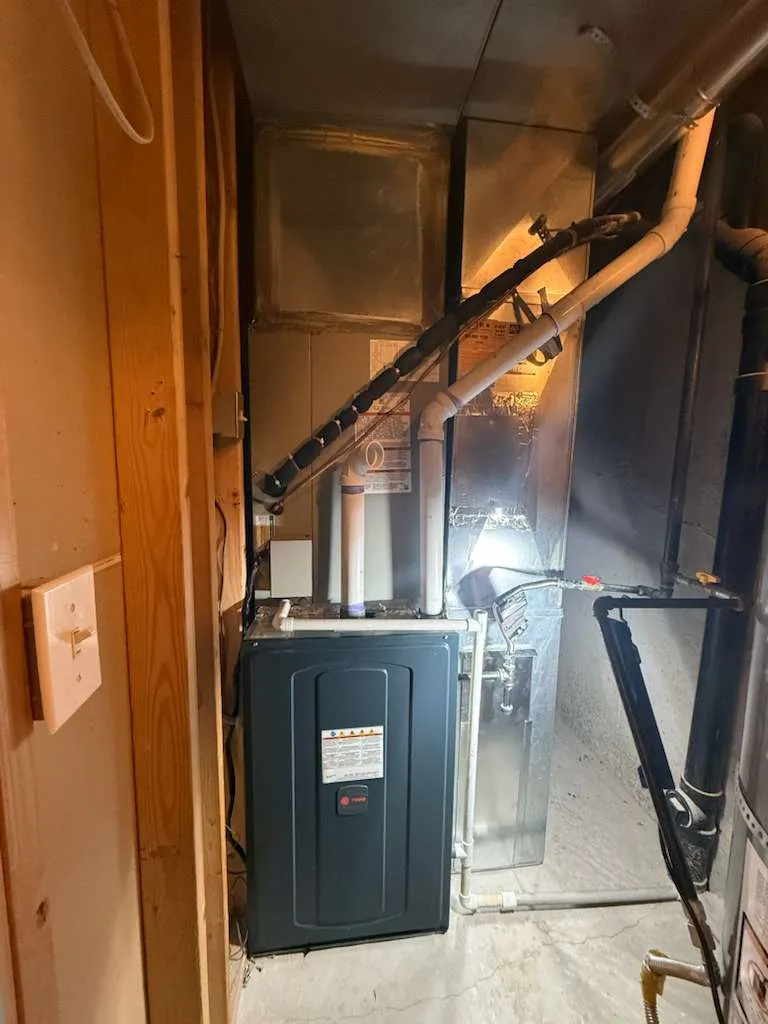
A furnace in an open basement costs less to replace than the same furnace wedged in an attic or a closet. Line-set length, venting changes, crane time for rooftop units, and whether your electrical panel has room all show up in the price — they're labor hours, not padding.
4. Ductwork condition
New equipment pushing air through leaky, undersized ducts is a fast car on flat tires. Plenty of Salt Lake Valley homes still run on ductwork from a swamp-cooler era that was never designed for central air. Sealing, resizing, or adding returns costs money up front and pays it back in comfort and utility bills — but it's a line item some bids skip so the total looks better.
5. Efficiency rating
Higher SEER2 (cooling) and AFUE (heating) ratings raise the sticker and lower the monthly bill. A 96%+ AFUE furnace runs about 30% more than a standard-efficiency model and, per HomeGuide's data, saves $200 – $400 a year on heating. Whether that math works for you depends on how long you'll own the home — an honest estimator will run it with you, not just upsell the biggest number.
6. Utah itself
Altitude thins the air, and equipment loses capacity as you climb — bench and mountain homes near 6,000 feet need sizing that accounts for it. Swamp-cooler conversions often need electrical work no national cost guide prices in. And along the Wasatch Front, inversion and wildfire-smoke filtration is a real add-on decision, not a gimmick. Local quirks like these are why Utah quotes stray from national averages.
Why two quotes for the same house can be $4,000 apart
Most of the spread between bids hides in what the cheap one leaves out. Before you compare totals, make sure each bid answers five questions:
- Is the permit included? Pulled permits mean inspected work. Skipping the permit is a discount you pay for later — especially when you sell the house.
- Did anyone run a load calculation, or did the tonnage get copied off the old unit's sticker?
- New line set and pad, or reused? Reusing a 20-year-old line set with new refrigerant is a shortcut with a failure rate.
- Is code-required electrical work in the price — disconnect, breaker, surge protection — or does it become a change order on install day?
- How long is the labor warranty? Parts warranties come from the manufacturer either way. Labor is where companies differ: the market standard is 1 – 2 years; every Lucas installation includes 5 years of labor coverage, free. We also register your manufacturer warranty for you, so the 10-year parts coverage doesn't quietly default to 5 because a card never got mailed.
Already holding a quote from another company? Bring it. We'll tell you straight if it's a fair deal — and if a repair makes more sense than the replacement they pitched, we'll say that too. Our free written second opinion puts that answer on paper you can compare quotes with.
Rebates and tax credits in 2026: what's still real
The federal 25C tax credit — the one worth up to $2,000 on qualifying heat pumps — expired December 31, 2025, and 2026 installations no longer qualify. If a website or a salesperson is still promising that credit on a 2026 install, slow down. What's still real: Rocky Mountain Power's Wattsmart rebates on qualifying heat pumps remain active, and Enbridge Gas still pays on high-efficiency furnaces. Current amounts, sources, and the fine print live on our Utah HVAC rebates page — and we check eligibility on every quote instead of printing numbers that go stale.
The prices we do post
Flat-rate work is different — no house-by-house variables, so we post those prices for everyone to see. The current flat diagnostic (waived with a repair), the working tune-up, whole-home duct cleaning, and the 5% military discount all live on our specials page, with no expiration-date games. Estimates for replacements and installs are free, always. And if the diagnostic finds a problem worth fixing, the fee comes off the repair.
What a furnace or AC tune-up costs
A full furnace or AC tune-up at Lucas Heating and Air costs $120, flat, in Salt Lake City and across the Wasatch Front. It is a working tune-up, not an inspect-and-quote visit: on a furnace the burners are cleaned, flame signal and gas pressure measured, safeties tested, and the heat exchanger visually inspected; on an AC the refrigerant performance is checked, electrical connections tightened, capacitor and motor readings taken, coils inspected, and the condensate drain cleared. One system per visit; duct cleaning and parts are separate, and anything worn is priced for you before it is replaced. Details and the other posted prices are on the specials page.
Utah HVAC cost questions, answered straight
- How much does a new AC unit cost in Utah?
- Across the Utah market in 2026, replacing a central air conditioner generally runs $3,500 to $9,000+ installed, per Angi's Utah cost data. Home size, equipment tier, efficiency rating, and ductwork condition decide where you land. Those are market-wide figures, not our quotes — replacement estimates are free.
- How much does it cost to replace a furnace in Utah?
- National cost guides put gas furnace replacement at $3,800 to $12,000 installed in 2026, with most mid-efficiency jobs landing between $4,500 and $6,300. High-efficiency (96%+ AFUE) models cost roughly 30% more but cut gas bills every winter. Your exact number depends on the home, which is why estimates are free.
- Why won't HVAC companies give a price over the phone?
- Because nobody can see your ductwork, electrical panel, equipment access, or the size your home actually needs from a phone call. A company that quotes a firm install price sight-unseen is guessing — and the guess gets corrected later, on your invoice. A real quote follows a look at the house. Ours are free and firm.
- Is the cheapest HVAC bid a mistake?
- Not always — but make the low bid explain itself. Check whether it includes the permit, a real load calculation, a new line set, code-required electrical work, and a labor warranty longer than one year. Low bids usually win by leaving those out. If it includes all five, it might just be a fair price.
- Are there still HVAC tax credits or rebates in Utah in 2026?
- The federal 25C credit (up to $2,000 on qualifying heat pumps) expired December 31, 2025, so 2026 installations no longer qualify. Rocky Mountain Power's Wattsmart rebates on qualifying heat pumps are still active. Amounts change by equipment and program year, so we check current eligibility on every heat pump quote.
- ¿Dan presupuestos gratis en español?
- Sí. Todo nuestro equipo es bilingüe — la visita, el presupuesto y las respuestas a sus preguntas pueden ser completamente en español. Los presupuestos para reemplazos e instalaciones son gratis, sin compromiso. Llame o mande un texto al (801) 678-5748.
Ready for a number that's actually yours? Estimates are free, firm, and pressure-free — in English or Spanish. Phones answered Monday – Friday, 8 AM – 8 PM.
Spreading the cost out? See how financing works — checking your options won't affect your credit.