
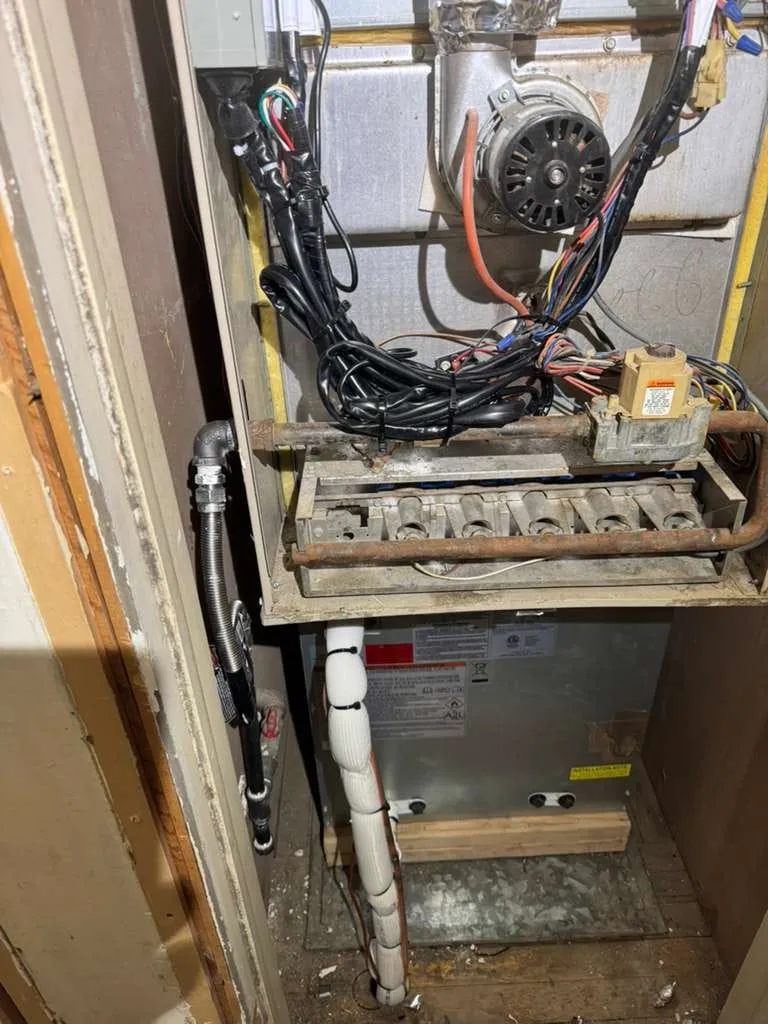
The furnace that will not turn on is the most common call we take between the first freeze and Thanksgiving, and about a third of those calls end with our technician flipping a switch the homeowner did not know existed. We would rather you find that switch yourself. So here is the same checklist our dispatcher walks people through on the phone, in the order that finds the problem fastest. Eight minutes, no tools, and the only rule is that you stop at the first step that fixes it.
One rule before you start. If you smell gas anywhere in this process, leave the house before you do anything else, then call Enbridge Gas (formerly Dominion Energy) at 1-800-767-1689, or 911, from outside. Gas first, furnace second, every time.
1. The thermostat
More dead furnaces are dead thermostats than anyone likes to admit.
- Batteries. If the screen is blank or dim, that is the whole problem. Most thermostats take two AA or AAA batteries behind the faceplate.
- Mode and setpoint. It has to be on Heat, not Cool or Off, and the setpoint has to be at least three degrees above the room temperature or nothing will call for heat. Turn it up to 75 for this test.
- Fan on Auto. If the fan is set to On, the blower runs all the time and the house feels cold even when the burners fire normally.
- Schedules and holds. A programmed setback or a “hold until” from last spring can keep a smart thermostat from calling for heat when you expect it. Set a manual hold at 75 and see if the furnace responds.
If the screen is on and you have raised the setpoint, wait five minutes. Many thermostats have a built-in delay before they call for heat, and most furnaces add another thirty to ninety seconds before the burners light. Patience finds a surprising number of “broken” furnaces.
2. The furnace power switch
Every furnace has a switch that looks exactly like a light switch, mounted on the side of the cabinet or on the wall next to it. Because it looks like a light switch, people turn it off. Kids do it, guests do it, painters do it, and the person who changed the filter in April did it. Flip it on. If the furnace was in a lockout, this also resets it, which is why this step comes second.
3. The breaker
Find the breaker labeled furnace, or FAU, or heat, and look for a handle sitting between On and Off. Push it fully off, then fully on. Once. If it trips again immediately, leave it off and call; a breaker that will not hold is protecting a shorted motor or a wire, and resetting it repeatedly is how a small repair becomes a fire.
High-efficiency furnaces are sometimes on a plug in a nearby outlet with a GFCI reset button. Push the button.
4. The panel door
The furnace has a safety switch behind the lower panel door that cuts all power when the door is off. A door that was put back after a filter change and is not fully seated will leave the furnace dead with no lights at all. Press the door firmly into place, and make sure it is latched at the top and the bottom.
5. The filter
A clogged filter does not usually stop a furnace from starting. It stops the furnace a few minutes in. The burners light, the heat exchanger gets too hot because not enough air is moving across it, the high-limit switch opens, the burners shut off, and the furnace tries again. Three or four of those and the control board locks out.
If your furnace starts and quits, or the air at the vents is hot for a minute and then stops, pull the filter and hold it up to a light. If you cannot see light through it, replace it, then reset the furnace at the power switch. This is also the moment to open every supply vent in the house and clear the return grilles.
6. The condensate drain (high-efficiency furnaces only)
If your furnace vents through two white PVC pipes instead of a metal flue, it is a condensing furnace and it makes water while it runs. That water leaves through a trap and a small drain line, often into a condensate pump with a float switch. When the line clogs or the pump fails, the float switch shuts the furnace down to keep it from flooding the floor.
Look for a small plastic box with a hose coming out of it near the base of the furnace, and for water on the floor. If the pump reservoir is full and the pump is silent, that is your problem. Clearing the line is a technician job on most units, but knowing it is the cause saves you a night of guessing.
7. The gas supply
The gas valve on the pipe feeding the furnace should have its handle parallel to the pipe. Perpendicular is off. Nobody turns this off by accident, but a plumber, a water-heater install, or a home inspection last month might have.
Then check another gas appliance. If the stove, the water heater, or the fireplace will not light either, the problem is upstream of the furnace and you need Enbridge Gas, not us.
8. The blink code
If everything above checks out and the furnace still will not run, look through the small window in the lower panel for a light. Most furnaces built in the last twenty-five years have a status LED on the control board.
- Steady on usually means the board is powered and idle, which points back to the thermostat or the wiring between them.
- A repeating pattern of blinks is a fault code. Count the blinks in each group, then find the chart printed inside the panel door or on the wiring label in the cabinet. Common ones name a pressure switch that is stuck, an ignition lockout, a limit switch that opened, or a flame sensed when it should not be.
- No light at all with the power switch on and the door seated points to a blown fuse on the control board or a dead transformer.
Whatever the pattern is, write it down. When you tell us “three blinks, then a pause” on the phone, our technician knows what to put on the truck before leaving the shop.
The four things you cannot fix from outside the cabinet
If you have done the eight steps and the furnace still will not run, or it runs and quits, the cause is almost always one of these, and every one of them is a routine repair:
- A dirty flame sensor. The furnace lights, runs for a few seconds, and shuts off, over and over. The sensor is coated and cannot prove to the board that there is a flame. Cleaning it takes minutes; replacing it is not much more.
- A failed hot-surface igniter. The inducer runs, the gas valve clicks, but nothing ever glows or lights. Igniters are brittle and simply wear out. This is the single most common furnace part we replace in October.
- A pressure switch or a blocked vent. The inducer runs but the sequence never advances. Sometimes a wasp nest in the intake pipe, sometimes a cracked hose on the switch, sometimes the switch itself.
- A control board or a blower motor. Less common, more expensive, and worth a conversation about the furnace’s age before you decide.
Please do not try to replace an igniter with a part from the hardware store or bypass a pressure switch you found on a video. The safeties on a gas furnace exist because the alternative to a furnace that will not run is a furnace that runs when it should not.
What it costs to find out
Our furnace repair diagnostic is a flat $69, and it is waived if we do the repair. All makes and models, whether or not we installed it, and we tell you what we found before we fix anything. Most of the no-heat calls above end with a part that costs far less than a week of worrying.
If the furnace is on its twentieth winter and the part that failed is the expensive kind, we will show you the numbers both ways: the repair, and a replacement that finishes in one day with a free 5-year labor warranty. The decision stays yours. And if someone has already told you the furnace is done, a second opinion is free.
Did the checklist run out before the furnace turned on? Call or text (801) 678-5748, Monday through Friday, 8 AM to 8 PM, in English or Spanish. Tell us the blink code if you have one.