
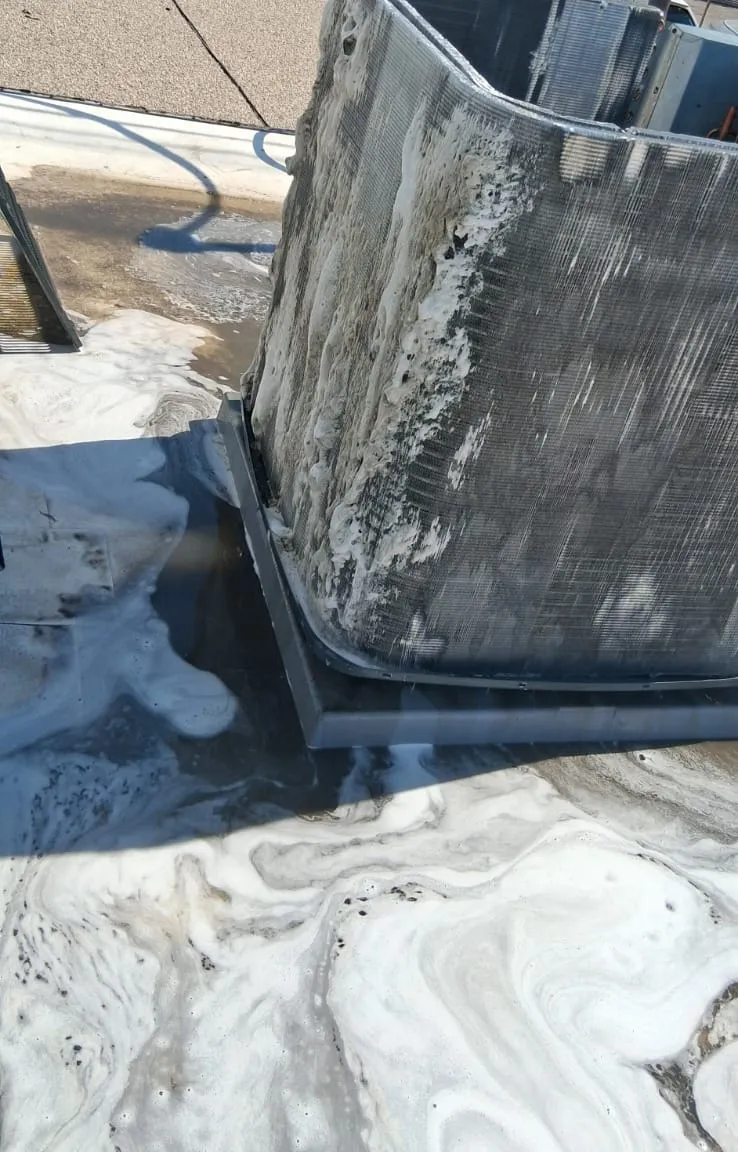
Most air conditioners along the Wasatch Front have run their last real cooling day of the year by the third week of September. What you do in the next few weekends decides how the unit starts next June: clean and dry, or packed with a summer’s worth of cottonwood fluff, grass clippings, and dust that has baked onto the coil since July.
The good news is that the part of AC cleaning that matters most is the part you can do yourself, with a garden hose, in about an hour. Here is the honest version: what to do, what to skip, and the one common “winterizing” habit that does more harm than good.
First, kill the power
Every outdoor unit has a disconnect box on the wall next to it, usually a grey metal box with a pull-out block or a breaker inside. Pull it, or flip the breaker for the AC at the panel. Then go inside and set the thermostat to Off so nothing tries to start while you are working.
This is not optional. The fan blade inside that cabinet can start on its own from a thermostat call, and the capacitor in the electrical compartment stores a charge even with the power off. Stay out of that compartment entirely. Everything below happens on the outside of the cabinet.
Clean the outdoor unit (the part worth doing)
- Clear the area. Pull weeds, trim shrubs, and rake out anything within two feet of the cabinet. The unit needs open air on all sides to dump heat. A condenser boxed in by juniper or a fence panel runs hot all summer.
- Lift out the loose debris. Leaves, cottonwood fluff, and grass collect against the coil fins on the outside and in the bottom of the cabinet. Pick out what you can reach by hand or with a shop vac on the brush attachment.
- Rinse the coil from the inside out. This is the step most people get backwards. Dirt is driven into the fins from the outside, so blasting the outside pushes it deeper. Use a garden hose with the nozzle on a gentle setting, aim through the top grille so the water flows out through the fins, and work around the whole cabinet. If you can only reach the outside, keep the pressure low and hold the hose straight on, not at an angle.
- Do not use a pressure washer. The aluminum fins on a condenser coil bend with a fingernail. A pressure washer folds them flat in seconds, and a folded fin blocks airflow permanently. If a section is already bent, a fin comb from a hardware store straightens it.
- Check the top. Look through the fan grille for nests, twigs, or anything sitting on the fan blade. Clear it out from above; do not put your hand in past the grille.
- Let it dry, then restore power. Give the unit an hour in the sun, then push the disconnect back in and set the thermostat back to your normal setting. If the day is warm, run it for ten minutes and make sure the fan spins and the air off the top is warm.
That is the whole job. In a neighborhood with cottonwoods, doing it once in June and once now keeps the coil clear year-round.
Inside the house: the filter and the drain
Two indoor items belong on the same weekend:
- Change the filter. The furnace filter is the AC filter too. A filter that ran all summer is full, and it will be the first thing to strain the blower when the furnace comes on in October.
- Check the condensate drain. Find the PVC line off the furnace cabinet and look for standing water or a wet floor. A drain that clogged in August will show itself now. Pouring a cup of distilled white vinegar down the drain line every few months keeps algae from building up.
The evaporator coil, the one inside the furnace cabinet above the burners, is not a homeowner cleaning item. Getting to it means opening the sealed cabinet, and cleaning it means the right foaming cleaner and a drain pan that is set up to carry the rinse away. If it is dirty enough to matter, you will usually see it as weak airflow or ice on the refrigerant lines during the summer, and it belongs on a tune-up visit.
Please do not tarp the unit
Every fall we see condensers wrapped in a tarp or a fitted plastic cover cinched down over the whole cabinet. The intention is good. The result is not:
- Moisture gets trapped. Utah winters swing from wet to dry and back. A sealed cabinet sweats on the inside, and that water sits on the coil, the fan motor, and the contacts all winter.
- Mice move in. A dark, dry, covered box next to a warm house is a perfect winter home, and mice chew wire insulation. A condenser that will not start in June because of a chewed low-voltage wire is a common spring service call.
- It does not protect anything that needs protecting. These units are built to sit outside in the weather. Snow on the coil does no harm.
If you have a unit directly under a roof edge where ice falls, or a tree that drops a lot of debris over the winter, put a piece of plywood weighted on top, or a breathable cover that covers the top only. Leave the sides open so air moves and the cabinet stays dry.
Where the pros pick up
A working tune-up covers the outdoor cleaning above and then goes where a homeowner should not: refrigerant pressures checked against the manufacturer’s chart, the capacitor and contactor tested, motor amp draws measured, the evaporator coil inspected and cleaned if it needs it, the drain cleared, and the electrical connections tightened. On our $120 full working tune-up, the cleaning is part of the visit, not a separate line item.
The end of the cooling season is also the best time to hear bad news calmly. A compressor that struggled through August or a system that ran on low refrigerant will show up in those readings. Finding out in September means you decide what to do on your schedule, instead of during the first hot week of June when every shop in the valley is booked. And if a system is on its last legs, an early estimate lets you use the off-season quiet to compare options without pressure. Our estimates on replacements are free, in English or Spanish, and every install we do finishes in one day.
Want the inside half done right? Book a $120 tune-up or call or text (801) 678-5748, Monday through Friday, 8 AM to 8 PM. All makes and models, whether or not we installed it.