
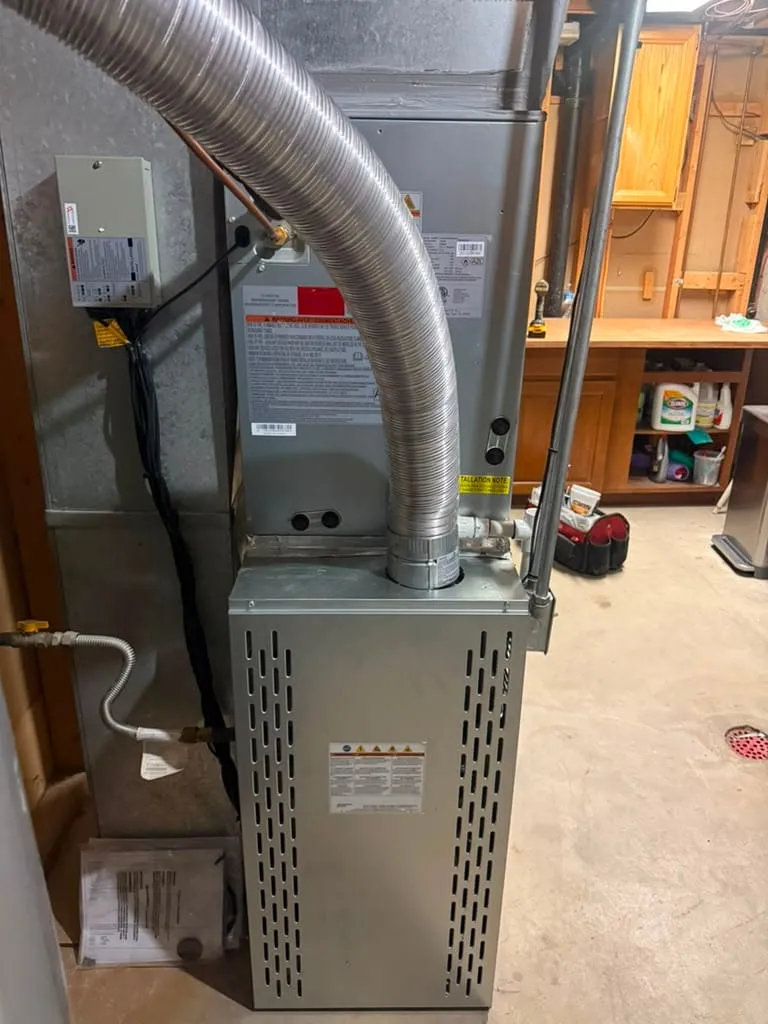
Every furnace sales pitch in the valley leans on the same sentence: “the high-efficiency unit pays for itself.” Sometimes it’s true. Sometimes the person saying it hasn’t looked at where your furnace sits, where the nearest exterior wall is, or whether there’s a drain within twenty feet. This is the version of the conversation we have at kitchen tables, with the parts most pitches leave out.
What the numbers mean
AFUE is the share of the gas you burn that actually becomes heat in your house over a season. An 80% furnace sends about a fifth of every therm up the flue as hot exhaust. A 96% furnace (the common high-efficiency tier; you’ll also see 95% and 97%) runs the exhaust through a second heat exchanger and pulls most of that heat back out. The exhaust gets cool enough that water vapor condenses out of it, which is why these are called condensing furnaces, and why they need a drain.
On the gas you burn for heating, moving from 80% to 96% means using roughly one-sixth less fuel for the same warmth. That’s the whole upside, and it’s a real one over a Wasatch Front winter. Everything else in this article is about what it costs to get it.
Where the 96% furnace earns its price
The heating season is long here. The savings are a percentage of your heating gas, so the more you heat, the more a 96% unit returns. A big two-story with the thermostat at 70 from October through April is the ideal candidate. A small, tight rambler with a modest gas bill has less to save.
The rebate is on the table. Enbridge Gas’s ThermWise program pays a rebate on qualifying high-efficiency furnaces, and unlike the utility electric rebates, it works in Murray, Bountiful, and Lehi too because it’s gas-side. Our Utah rebates page has the verified current amounts. The federal 25C tax credit is gone as of the end of 2025, so don’t let anyone count it.
The venting is easy. A condensing furnace vents through PVC pipe, not a metal flue, and the pipe has to reach outside within a limited run. If your furnace is in a basement or utility room near an exterior wall, that’s a short, clean job. If there’s a floor drain or a laundry standpipe nearby for the condensate, better still.
You’re staying. Fuel savings are a per-year return. If you plan to be in the house long enough for the savings and the rebate to cover the price gap, the 96% unit wins. If you’re likely to sell in a couple of years, the next owner collects most of the benefit.
Where the 80% furnace is the smarter buy
This is the half most pitches skip.
The furnace is far from an exterior wall. Long PVC runs, extra elbows, and routing through finished space add cost fast. On some older Salt Lake City homes with the furnace in the middle of the basement, the venting alone changes the payback math from “a few years” to “longer than the furnace will last.”
There’s no drain. Condensate has to go somewhere. Without a floor drain or standpipe nearby, that means a condensate pump and a line to a drain, one more moving part to maintain and one more thing that can fail in February.
The water heater shares the flue. In a lot of valley homes, the old furnace and the gas water heater vent up the same metal chimney. Pull the furnace off that flue and the water heater is left venting alone into a chimney sized for both. That “orphaned” water heater often needs a flue liner or its own re-venting to draft safely. That’s a real cost, and a safety item, that belongs in the quote. A contractor who doesn’t mention it hasn’t looked.
The budget is tight and the house is small. An 80% furnace installed and commissioned correctly is not a compromise on comfort. It heats the house, it’s simpler, and it costs less up front. For a modest home with a modest gas bill, it can be the plainly correct choice.
The part that matters more than the tier
Whichever number is on the box, two things decide whether you’re warm on the worst night of January.
Sizing for altitude. Gas furnaces lose capacity as the air thins, and Salt Lake City sits above 4,200 feet, with bench and canyon homes higher. A furnace picked from a catalog at sea-level ratings comes up short exactly when you need it. We size from your home’s actual heat loss, then derate for elevation, on every job. Oversizing to “be safe” is its own mistake: a too-big furnace short-cycles, wears out early, and heats unevenly.
Two-stage or modulating burners. Utah winters swing between mild afternoons and brutal nights. A furnace that can run low and slow most of the time keeps rooms more even, cycles less, and is quieter than a single-stage unit slamming on and off. Two-stage 80% furnaces exist and are often the sweet spot for a mid-size home that can’t justify the condensing tier.
How to actually run the numbers
Skip the “pays for itself” line and ask for three figures for your house:
- The installed price gap between the 80% and 96% options, including any venting, drain, or water-heater flue work, minus the ThermWise rebate.
- Your heating gas usage, from last winter’s bills. Your contractor can estimate the annual savings from that; you don’t need a spreadsheet, just the number.
- Years to break even: the gap divided by the savings.
If the answer is a few years and you’re staying, the 96% furnace is a good buy. If the answer is most of the furnace’s life, the 80% unit is. Both are correct answers for the houses they fit, and we install plenty of each.
Our furnace installation page walks through what we check on every estimate, the local write-ups cover the houses where the answer tips one way, like the two-story benches in Sandy and the split-levels in Bountiful, and the Utah HVAC cost guide has the market-wide price ranges so you can sanity-check any quote. If you’re already holding a quote that pushes one tier hard without those three numbers, that’s exactly what our free written second opinion is for.
What we’ll do at your house
Price both paths, in writing. Show you the venting route and where the condensate would go before you decide. Check the water heater’s flue. Size for altitude. Then tell you what we’d install in our own basement, and let you make the call. Some customers leave with the 96% unit, some with the 80%, and every one of them gets the same commissioning and the same free 5-year labor warranty, because the install decides how long either one lasts.