
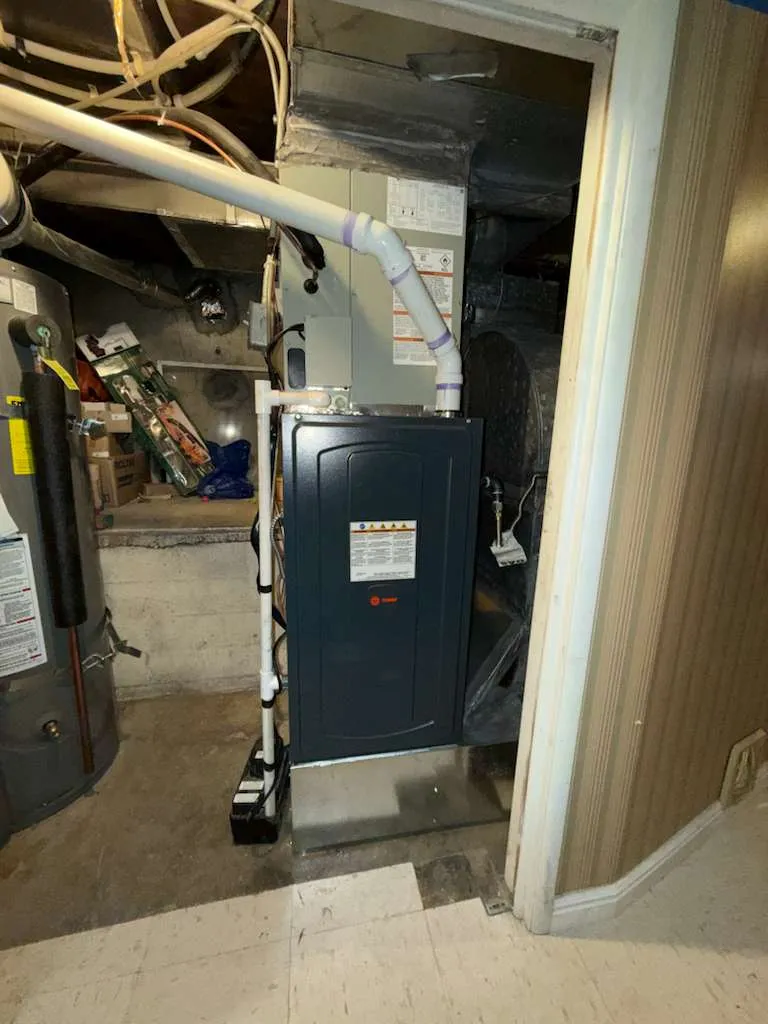
Every October the same question arrives in our inbox, usually right after a neighbor’s install or a rebate flyer: “Should I replace my furnace with a heat pump?” The sales answer is yes, always. The honest answer is that it depends on four things about your house that have nothing to do with the equipment brochure. Here is how we walk through them at an estimate, so you can run the same math before anyone is sitting at your kitchen table.
First, what a heat pump actually is
A heat pump is an air conditioner that can run in reverse. In summer it moves heat out of your house; in winter it pulls heat out of the outdoor air, even cold air, and moves it inside. Because it moves heat instead of making it, a heat pump delivers more heat energy than the electricity it uses, which is where the operating-cost savings come from.
The catch is physics: the colder it gets outside, the less heat there is to move, so output and efficiency both slide as the temperature drops. Older heat pumps gave up somewhere around freezing and ran on expensive electric resistance strips below that. Modern cold-climate models keep producing useful heat well below zero. That change is why the question is worth asking in Utah at all now.
Question 1: Who sends your power bill?
This decides the rebate before anything else. Rocky Mountain Power’s Wattsmart program pays up to $1,600 on qualifying air-source heat pumps, up to $1,700 on ductless models, and up to $1,450 on dual-fuel systems. Those amounts are real, and they move the math.
But Murray, Bountiful, and most of Lehi run their own municipal electric utilities, and Wattsmart does not apply there. If your power bill does not say Rocky Mountain Power, cross the electric rebate off the list. The gas side is different: nearly everyone along the Wasatch Front is on Enbridge Gas, so the ThermWise rebate, $300 to $350 on a high-efficiency furnace and up to $1,200 on dual-fuel, works in all three cities.
One more thing a flyer may not tell you: the federal 25C tax credit, the one that paid up to $2,000 on heat pumps, expired December 31, 2025. Equipment installed in 2026 does not qualify. The current verified amounts live on our rebates page, and we only list what we have checked that month.
Question 2: How old is your air conditioner?
Because a heat pump is also your air conditioner, the clean moment to switch is when the AC is at the end of its life too. Then one outdoor unit and one indoor coil replace two aging systems, and you collect one rebate on the whole thing.
If your air conditioner is young and healthy, the picture changes. A heat pump would retire a working AC early, and that is money thrown away. In that case a straight furnace replacement, or a dual-fuel setup that keeps what you have, is usually the smarter spend. We cover the furnace side of that decision in 80% or 96%?.
Question 3: What does your electrical panel look like?
A heat pump with backup heat strips wants a dedicated circuit that an older 100-amp panel may not have room for. Sometimes that is a small breaker addition; sometimes it is a panel upgrade that belongs in the quote before you compare it to a furnace. A gas furnace needs almost nothing electrically. We look at the panel at every heat pump estimate, and if the electrical work changes the answer we say so rather than burying it in a change order.
Question 4: How do you feel about the coldest nights?
This is the one people skip. On a January night at 5 degrees on the bench, a cold-climate heat pump is still working, but it is working hard, at its lowest output and its lowest efficiency, and the house feels it as air from the vents that is warm rather than hot. Some homeowners never notice. Others, especially in bigger or draftier homes, want the blast of a gas furnace on those nights.
That preference is legitimate, and it points to the option most Utah homes land on.
The middle path: dual-fuel
A dual-fuel system pairs a heat pump with a gas furnace on the same ductwork. The heat pump runs the mild and moderate days, which is most of our winter, at the lower operating cost. When the outdoor temperature drops past a changeover point we set in the thermostat, the furnace takes over and delivers the hot, fast heat gas is good at. You get the shoulder-season savings, the heat pump rebate, the furnace rebate on the gas side, and a backup that does not care how cold it gets.
Dual-fuel makes the most sense when the furnace and the AC are both due, or when a decent furnace is staying and only the AC is being replaced. The controls have to be set up properly, which is a detail we handle on install day and check at the first tune-up.
Where we land for most houses
- AC and furnace both aging, Rocky Mountain Power customer: dual-fuel or a cold-climate heat pump is worth a real look. Both rebates stack.
- Furnace aging, AC newer: replace the furnace, keep the AC. Decide between 80% and 96% on your venting, not on a slogan.
- Murray, Bountiful, or Lehi city power: the electric rebate is gone, so a heat pump has to pencil on operating cost alone. For many homes it does not, and a high-efficiency furnace with the ThermWise rebate wins.
- All-electric by preference: a cold-climate heat pump sized for your elevation, with the electrical work priced up front.
None of those are rules; they are starting points. The deciding numbers are your gas and power rates, your home’s heat loss at our altitude, and what you already own, and those only come out of a visit to the house.
What the estimate includes
A heat pump estimate from us prices the options side by side: the straight furnace replacement, the cold-climate heat pump, and the dual-fuel pairing, each with the rebate it actually qualifies for and the electrical work spelled out. Every install finishes in one day with the free 5-year labor warranty, and the heat pump page covers the equipment we install and how we size it. If someone has already quoted you one of these and you want a second set of eyes, the second opinion is free.
Trying to decide before the first real cold snap? Call or text (801) 678-5748, Monday through Friday, 8 AM to 8 PM, in English or Spanish. Estimates are free, and we will tell you which option we would put in our own house.