
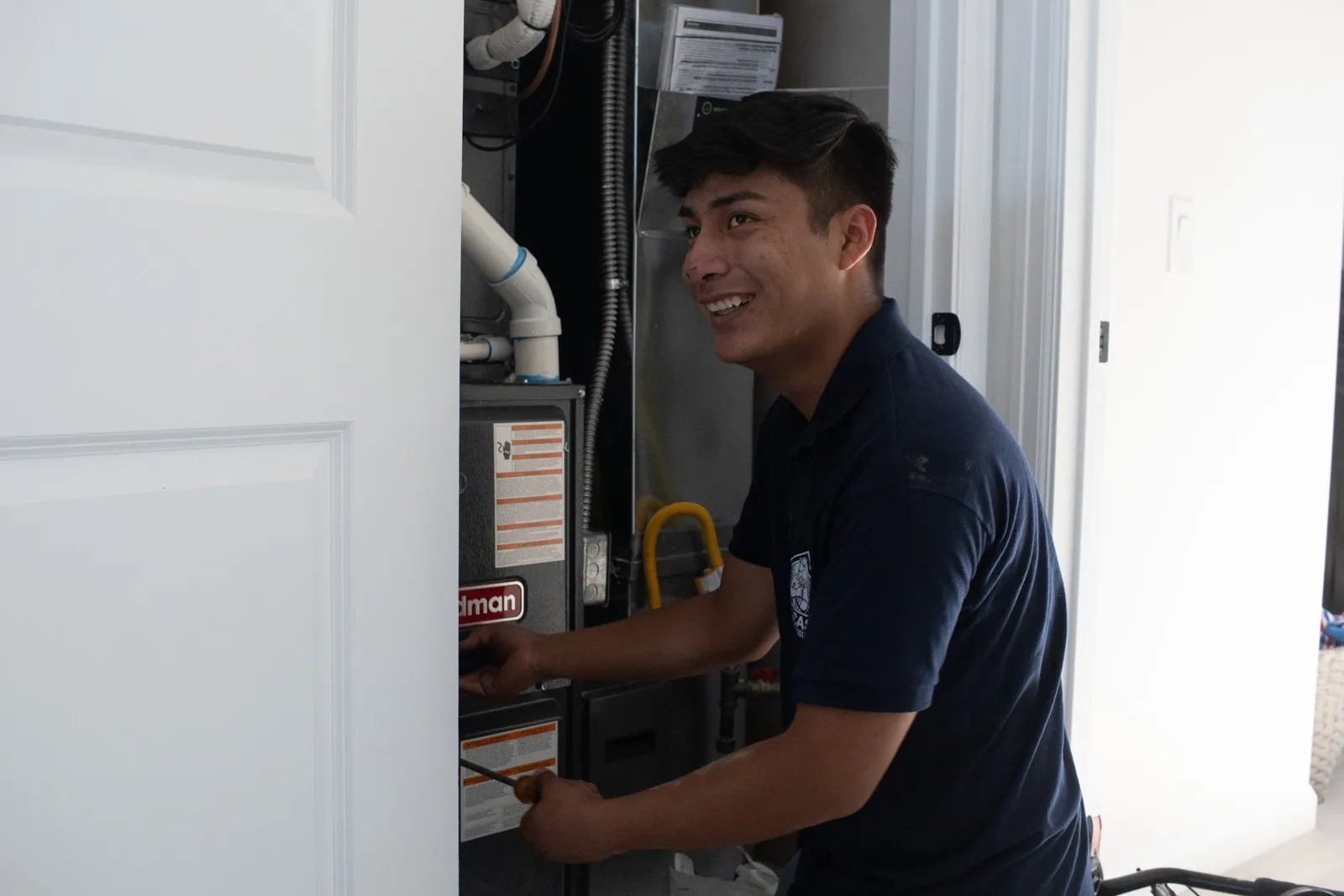
The furnace comes on. You hear the burners light, warm air starts moving, and two or three minutes later it all goes quiet. A few minutes after that, it starts again. The house never quite gets warm, and the furnace never quite stops trying. That is short cycling, and from late October through the first real cold of November it is one of the calls we take most.
Here is the useful thing to know first: short cycling is almost never the furnace being random. Something specific is cutting each cycle short, and the list of usual suspects is short. Three of them you can check yourself tonight for free. The rest need a technician, and one of them needs one soon.
One rule before anything else. If you smell gas, leave the house first and call Enbridge Gas (formerly Dominion Energy) at 1-800-767-1689, or 911, from outside. And if a carbon monoxide detector goes off, do the same. We cover the warning signs in our carbon monoxide and furnace safety guide.
What normal looks like
On a cool fall day, a healthy furnace typically runs a few cycles an hour, and each one lasts long enough to move warm air through the whole house, not just past the thermostat. On the coldest January nights it runs much longer and may barely stop. Cycles of two or three minutes, repeated all day, are not normal at any temperature.
Count it once. Note the time when the burners light and when they go off, and do that for three or four cycles. That number helps you below, and it helps us if you call.
The three you can check tonight
1. The filter. This is the most common cause we find, by a wide margin. A clogged filter chokes airflow across the heat exchanger, the exchanger overheats, and a high-limit switch shuts the burners off to protect it. The blower keeps running until things cool, then the burners light again, and the loop repeats. Pull the filter and hold it up to a light. If you cannot see light through it, replace it and give the furnace an hour. Salt Lake City’s inversion season and a house full of fall dust can load a filter much faster than the package suggests.
2. The vents and registers. Closed supply registers and blocked returns cause the same overheating as a dirty filter. Walk the house and open every register, and pull furniture and rugs off the returns. Closing vents in unused rooms to “save heat” is one of the quieter ways to make a furnace short cycle.
If you have a high-efficiency furnace with two white PVC pipes leaving the house, go outside and look at both ends. Leaves, a bird or wasp nest, or drifted snow and ice on the intake or exhaust will make the furnace shut down after a few minutes. Clear them by hand, carefully, and never with the pipes disconnected.
3. The thermostat. A thermostat mounted near a supply register, in afternoon sun, above a lamp, or next to the kitchen reads the house as warmer than it is and shuts the furnace off early. If you just installed a new thermostat and the short cycling started that week, check its settings for a cycle rate or “cycles per hour” option, and confirm it is set for the type of system you actually have. A weak battery can also make some models drop the call for heat.
If the furnace runs normal cycles after these three, you are done. If not, the cause is inside the cabinet.
The four that need a technician
4. A dirty flame sensor. The burners light, run for a few seconds to a minute, then shut off, and the furnace tries again. That pattern usually means the flame sensor, a small metal rod in the burner flame, is coated and cannot prove there is a flame, so the control board closes the gas valve as a precaution. It is a quick, inexpensive fix on a service call. After three failed tries most furnaces lock out completely, which is when it turns into a no-heat call. (Our furnace won’t turn on checklist covers that part.)
5. A worn high-limit switch. A filter that stayed dirty for a whole winter can leave the limit switch itself weak, tripping at a lower temperature than it should even after the airflow problem is fixed. A technician tests it with a meter and replaces it if it is out of spec.
6. An oversized furnace. This one never shows an error code. A furnace that is too big for the house heats the air near the thermostat in a few minutes, shuts off, and leaves the far bedrooms cold. It runs that way every winter, with more wear on the igniter and the blower than a properly sized furnace sees. It is common where a past replacement copied the old furnace’s size instead of running a load calculation. There is no repair for it, but you should know it is the cause before anyone sells you parts.
7. Exhaust or heat exchanger problems. A blocked flue, a failing inducer motor, or a cracked heat exchanger can trip the pressure switch or the rollout switch and end a cycle early. These are the safety switches working, and they are the reason not to keep resetting a furnace that keeps shutting itself down. A cracked exchanger is real and dangerous; a technician who finds one can show it to you. If someone tells you the furnace is done and cannot show you why, get a free second opinion before you sign anything.
Why it is worth fixing soon
Short cycling is hard on a furnace. Every start is the hardest moment of a cycle for the igniter, the inducer, and the blower motor, and a furnace that starts forty times a day instead of eight wears those parts several times faster. It also wastes gas, because the first minutes of every cycle are the least efficient, and it leaves rooms uneven because the warm air never runs long enough to reach them. A short-cycling furnace in October is often a no-heat call in January.
What it costs to find out
Our furnace repair diagnostic is a flat $69, and it is waived if we do the repair. All makes and models, whether or not we installed it, and we tell you what we found before we fix anything. Tell us how long the cycles are when you call. A few minutes with the burners on points one way; burners that drop out after seconds points another, and we arrive with the right parts.
If the cause turns out to be an oversized or very old furnace, we will show you both paths: what keeping it running costs, and a properly sized replacement with a load calculation, finished in one day, with a free 5-year labor warranty. The decision stays yours. And a $120 tune-up in the fall catches most of the causes above, the flame sensor and the limit switch included, before the first cold night finds them.
Still turning on and off after the filter and the vents? Call or text (801) 678-5748, Monday through Friday, 8 AM to 8 PM, in English or Spanish.